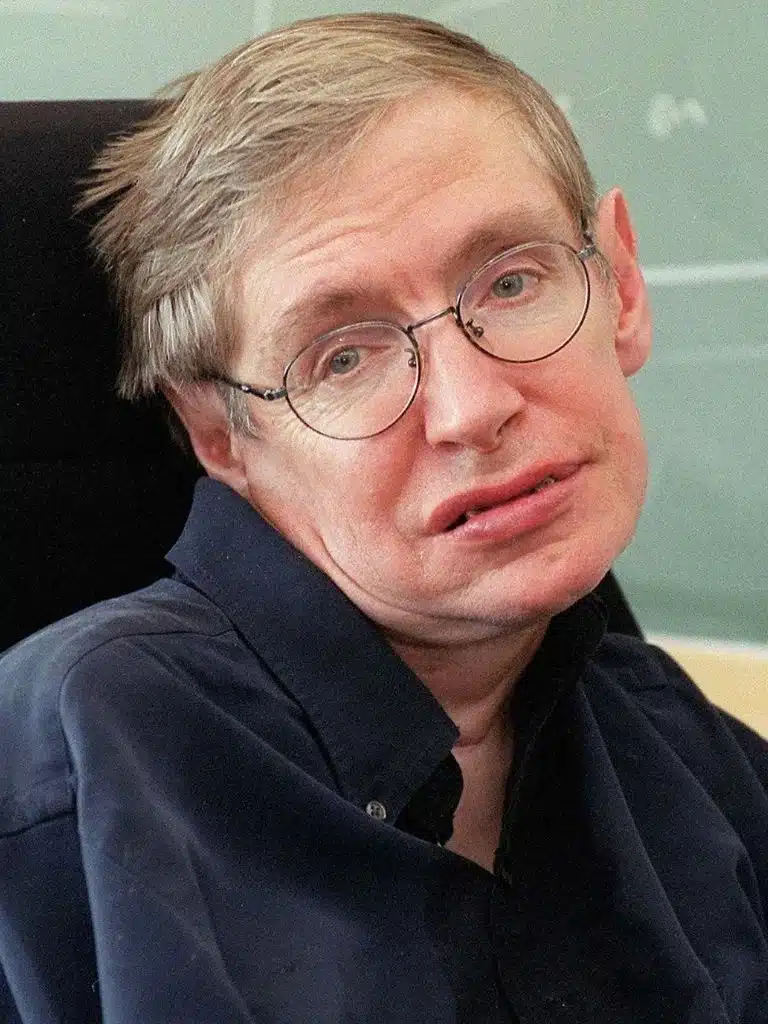
If you want to know more about Stephen Hawking, you are in the right place.
Stephen Hawking was an English theoretical astrophysicist, cosmologist, and author best known for his groundbreaking work on black holes and the origins of the universe.
He became popular for his scientific theories and his ability to explain complex ideas to the public. He is also known for his incredible resilience in the face of a debilitating illness.
In this article, you will learn about Stephen Hawking’s age, career, education, personal life, net worth, and other important details.
Stephen Hawking Wiki and Biography
Stephen Hawking was a brilliant mind who reshaped our understanding of the cosmos. Born on January 8, 1942, in Oxford, England, he was the son of Frank and Isobel Eileen Hawking, both physicians.
His family valued education highly, and he was inspired by his father's scientific research.
Hawking's early life was marked by a keen intellect, though he wasn't initially a standout student. He attended St Albans School before heading to University College, Oxford, to study physics.
Later, he pursued graduate studies at Trinity Hall, Cambridge, where he focused on general relativity and cosmology.
His life took a significant turn when, at age 21, he was diagnosed with motor neurone disease, a progressive condition that would gradually paralyze him.
| Stephen Hawking Wiki and Biography | Details |
|---|---|
| Full Name | Stephen William Hawking |
| Born On | 8 January 1942 |
| Birthplace | Oxford, England |
| Died On | 14 March 2018 |
| Place of Death | Cambridge, England |
| Age at Death | 76 years old |
| Nationality | English |
| Ethnicity | White |
| Mother’s Name | Isobel Eileen Hawking |
| Father’s Name | Frank Hawking |
| Siblings | Two younger sisters, Philippa and Mary; one older brother, Edward (died in infancy) |
| Education | University College, Oxford (BA Physics); Trinity Hall, Cambridge (PhD Applied Mathematics and Theoretical Physics) |
| Alma Mater | University of Oxford, University of Cambridge |
| Occupation | Theoretical Astrophysicist, Cosmologist, Author |
Stephen Hawking was a brilliant theoretical astrophysicist and cosmologist whose work changed how we understand the universe. Born in Oxford, England, in 1942, he was the son of medical researchers.
His early education took him to St Albans School and then to the University of Oxford, where he studied physics. He continued his studies at the University of Cambridge, earning a PhD in applied mathematics and theoretical physics.
Despite being diagnosed with motor neurone disease at a young age, which significantly impacted his physical abilities, Hawking's intellect and determination allowed him to make extraordinary contributions to science.
His intellectual curiosity and drive to understand the cosmos were evident throughout his life.
Stephen Hawking Height, Weight, and More
Stephen Hawking faced significant physical challenges due to his motor neurone disease. While his mobility and ability to speak were severely affected, his mind remained sharp and incredibly active.
He used a sophisticated speech-generating device to communicate, initially controlled by a switch and later by a single cheek muscle.
Despite his physical limitations, Hawking lived a remarkably full life. His condition, while progressive, was slow-moving, allowing him to continue his groundbreaking research and engage with the world.
His physical attributes, though impacted by illness, did not define the limits of his intellectual reach.
| Stephen Hawking Height, Weight, and More | Details |
|---|---|
| Height (in meters) | 1.60 m |
| Height (in feet) | 5 ft 3 in |
| Height (in inches) | 63 inches |
| Weight (in kg) | 50 kg |
| Weight (in pounds) | 110 lbs |
| Weight (in ounces) | 1760 ounces |
| Hair Color | White (previously brown) |
| Eye Color | Blue |
| Body Type | Slender due to illness |
| Distinguishing Features | Used a wheelchair and speech-generating device |
| Mobility | Wheelchair dependent |
| Speech | Used a speech-generating device |
Stephen Hawking's physical journey was one of immense challenges, yet his spirit remained unbroken.
While his height was around 1.60 meters (5 feet 3 inches) and his weight was about 50 kg (110 lbs), these numbers only tell part of the story.
He used a wheelchair for mobility and a speech-generating device to communicate, due to motor neurone disease. This condition gradually affected his body, but not his brilliant mind.
His blue eyes and white hair were familiar sights, often seen with a determined expression. Despite these physical limitations, Hawking lived a full life, traveling the world and continuing his scientific work.
Stephen Hawking Career Information
Stephen Hawking's career was marked by groundbreaking scientific achievements and a dedication to sharing knowledge.
He held prestigious academic positions, including the Lucasian Professor of Mathematics at Cambridge University, a post once held by Isaac Newton.
His research delved into the deepest questions about the universe, from the nature of black holes to the very beginning of time.
Hawking's contributions extended beyond theoretical physics. He became a beloved author, with his book "A Brief History of Time" becoming a global bestseller.
He was a Fellow of the Royal Society and received numerous awards, recognizing his immense impact on science and his ability to inspire millions. His career was a testament to the power of human intellect and perseverance.
| Stephen Hawking Career Information | Details |
|---|---|
| Primary Profession | Theoretical Astrophysicist, Cosmologist, Author |
| Director of Research | Centre for Theoretical Cosmology, University of Cambridge |
| Lucasian Professor of Mathematics | University of Cambridge (1979–2009) |
| Key Scientific Contributions | Gravitational singularity theorems, Hawking radiation, theory of cosmology combining general relativity and quantum mechanics, micro black holes |
| Notable Collaborations | Roger Penrose, George Ellis, Brandon Carter, Werner Israel, David C. Robinson, Kip Thorne, James M. Bardeen, Gary Gibbons, Jim Hartle, Leonard Mlodinow |
| Popular Science Books | A Brief History of Time, The Universe in a Nutshell, A Briefer History of Time, The Grand Design |
| Academic Honors | Fellow of the Royal Society (FRS), Lifetime member of the Pontifical Academy of Sciences |
| Major Awards | Presidential Medal of Freedom, Eddington Medal, Pius XI Gold Medal, Dannie Heineman Prize, Maxwell Medal and Prize, Hughes Medal, Albert Einstein Medal, Wolf Prize, Copley Medal |
| Recognition | Ranked #25 in BBC’s poll of the 100 Greatest Britons |
| Supervised PhD Students | 39 successful students |
| Retirement from Professorship | 2009 |
| Post-Retirement Role | Director of Research at Cambridge University Department of Applied Mathematics and Theoretical Physics |
| Space Exploration Involvement | Launched Breakthrough Initiatives to search for extraterrestrial life |
Stephen Hawking's career was nothing short of extraordinary. He held the prestigious Lucasian Professor of Mathematics position at Cambridge University from 1979 to 2009, a role once held by Isaac Newton.
His scientific work included revolutionary theories on black holes, such as Hawking radiation, and a unified theory of cosmology.
Beyond his academic pursuits, Hawking became a global icon through his popular science books, most notably "A Brief History of Time," which made complex scientific ideas accessible to millions.
He was recognized with numerous awards, including the Presidential Medal of Freedom, and was a Fellow of the Royal Society. He also supervised 39 PhD students, nurturing the next generation of scientists.
Stephen Hawking Net Worth Information
Stephen Hawking's financial success stemmed from his brilliant scientific mind and his ability to connect with a global audience. His bestselling books, including "A Brief History of Time," brought in significant royalties.
He also earned income from his academic positions and public speaking engagements.
While his primary focus was always on scientific discovery, Hawking's work had a profound commercial impact.
His ability to explain complex theories in an accessible way made his books incredibly popular, translating into substantial earnings.
He was awarded numerous honors and recognitions that also reflected his high standing in the scientific and public spheres.
| Stephen Hawking Net Worth Information | Details |
|---|---|
| Estimated Net Worth (USD) | $20 Million |
| Primary Source of Income | Book sales, Academic salary, Royalties |
| Book Sales (Estimated) | Millions of copies sold worldwide |
| “A Brief History of Time” Sales | Over 9 million copies by 2009 |
| Lucasian Professorship Salary | Significant academic remuneration |
| Royalties from Books | Substantial income from bestselling works |
| Public Speaking Fees | Commanded high fees for lectures |
| Endorsements/Advertisements | Appeared in advertisements for various products |
| Inheritance | Received some inheritance from family |
| Personal Assets | Properties, investments, personal belongings |
| Charitable Contributions | Supported various charities through his estate and foundation |
| Auction Proceeds (Personal Items) | Personal possessions, including wheelchair, sold for significant sums |
| Estate Value | Considerable value distributed after death |
| Financial Legacy | Supported scientific research and education through foundations |
Stephen Hawking's financial success was a reflection of his immense global impact.
His estimated net worth was around $20 million, primarily earned through the phenomenal sales of his books, particularly "A Brief History of Time," which sold over 9 million copies.
His tenure as the Lucasian Professor of Mathematics at Cambridge also provided a substantial academic salary.
Beyond these, Hawking commanded significant fees for his public speaking engagements, sharing his insights with audiences worldwide.
He also benefited from royalties on his extensive body of work and appeared in advertisements, further adding to his income.
His personal assets and the proceeds from the auction of his belongings contribute to his financial legacy, much of which supported scientific endeavors.
10 Interesting Facts About Stephen Hawking
1. Stephen Hawking was born on the same day Isaac Newton celebrated his 300th birthday.
2. He was diagnosed with motor neurone disease at age 21 and was given only two years to live.
3. Hawking’s famous speech synthesizer voice was originally an American accent.
4. He co-wrote children’s books with his daughter, Lucy Hawking, to explain science.
5. In 1974, he was elected a Fellow of the Royal Society, one of the youngest scientists to achieve this.
6. He made a bet with Kip Thorne about whether the X-ray source Cygnus X-1 was a black hole, which he eventually lost.
7. Hawking famously said that “philosophy is dead” because scientists had become the primary discoverers of knowledge.
8. He once held a party for time travelers, inviting guests only after the event to see if anyone could prove time travel was possible.
9. Hawking was a supporter of the Labour Party and universal healthcare.
10. His ashes were interred in Westminster Abbey between the graves of Isaac Newton and Charles Darwin.
Frequently Asked Questions
What was Stephen Hawking’s main scientific contribution?
Stephen Hawking’s most famous contributions include his work on gravitational singularities, the theory of Hawking radiation from black holes, and his efforts to unify general relativity and quantum mechanics.
How did Stephen Hawking communicate?
Due to his motor neurone disease, Stephen Hawking communicated using a speech-generating device, initially controlled with a hand switch and later by movements of his cheek muscles.
What was Stephen Hawking’s most famous book?
His most famous book is “A Brief History of Time,” which explained complex cosmological concepts to a general audience and became a global bestseller.
Did Stephen Hawking believe in God?
Stephen Hawking was an atheist, stating that the simplest explanation is that there is no God and that we have this one life to appreciate the universe.
What was Stephen Hawking’s profession?
He was a theoretical astrophysicist, cosmologist, and author.
How old was Stephen Hawking when he died?
Stephen Hawking was 76 years old when he passed away on March 14, 2018.
Where did Stephen Hawking work?
He was a professor at the University of Cambridge for many years, holding the prestigious Lucasian Professorship of Mathematics.
What illness did Stephen Hawking have?
He had a rare form of motor neurone disease (MND), also known as amyotrophic lateral sclerosis (ALS).
Did Stephen Hawking ever travel to space?
No, he never traveled to space, although he had a strong desire to do so and even experienced weightlessness on a zero-gravity flight.
What was the significance of the equation on Stephen Hawking’s memorial stone?
The equation describes the temperature of Hawking radiation emitted by black holes, representing one of his most important scientific discoveries.
Conclusion
Stephen Hawking was a truly remarkable individual whose impact on science and the world is immeasurable. His groundbreaking theories about the universe challenged our understanding and opened new avenues of research.
Despite facing immense personal challenges with motor neurone disease, he remained a dedicated scientist and an inspiring figure.
His ability to simplify complex ideas in his books made cosmology accessible to millions, solidifying his place as one of history's most important scientific communicators.
Hawking's legacy lives on through his theories, his writings, and the inspiration he provided to countless people around the globe.